In May 2026, two papers published in 2025 by the research team led by Professor Xiang Leiwen, Director of the Fujian Province - Indonesia Marine Food Joint Research and development Centre, in collaboration with Nanjing University, Hangzhou Medical College and several other institutions, were both selected as ESI Highly Cited Papers. Both papers were published in Food Chemistry (one of the top journals in the Chinese Academy of Sciences 1st Quartile, with an Impact Factor of 9.8 and a current Impact Factor of 10.4). Fujian Polytechnic Normal University (FPNU) was listed as the first-author institution for both papers.
Essential Science Indicators (ESI) is a key bibliometric analysis tool published by Clarivate. It is widely used to measure scientific research performance, track trends in academic disciplines and assess the academic influence of universities, research institutions and countries and regions. Among these, ESI Highly Cited Papers refer to articles published in the last decade that rank in the top 1% globally in terms of citation frequency within the same discipline and publication year; thus, it is one of the key indicators for measuring the international impact and academic standing of research achievements.
The ESI Highly Cited Papers are as follows:
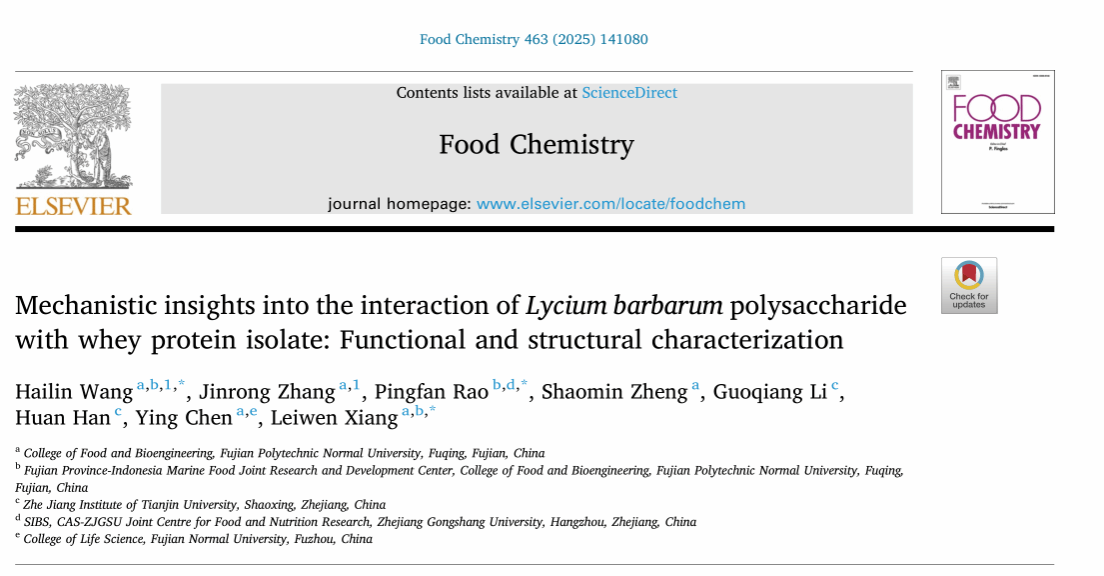
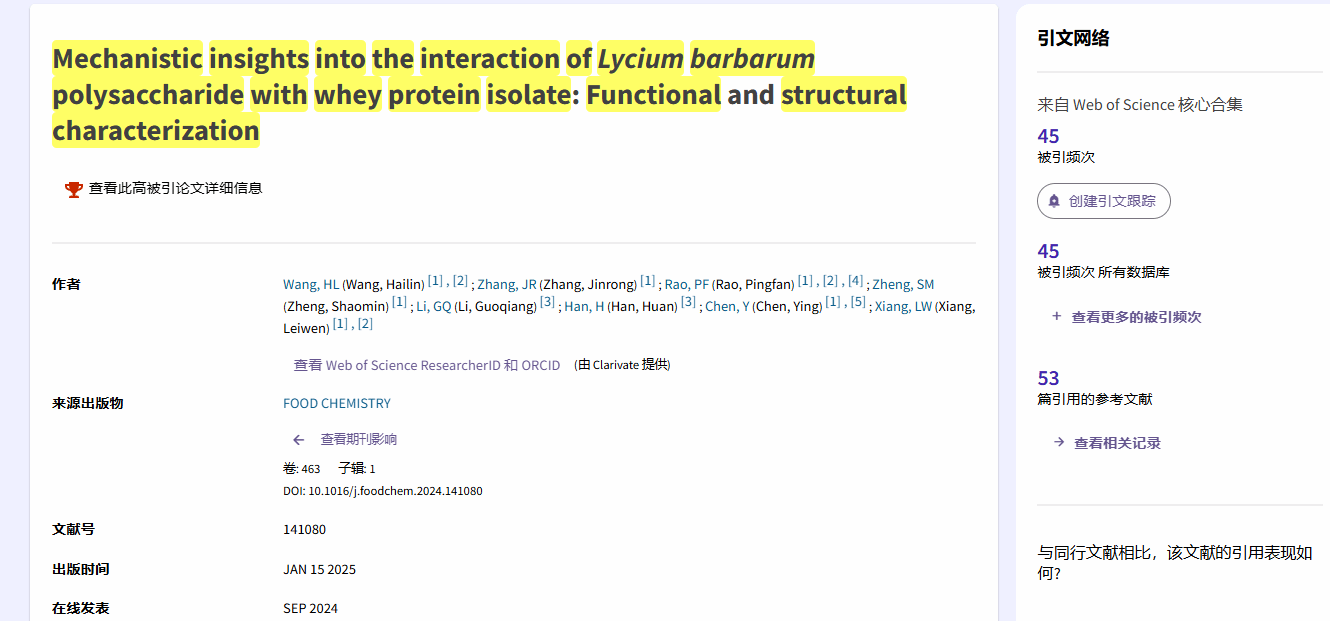
Mechanistic insights into the interaction of Lycium barbarum polysaccharide with whey protein isolate: Functional and structural characterization
Research overview: This study investigated the interaction between Lycium barbarum polysaccharide (LBP) at different concentrations (0–2.00%) and whey protein isolate (WPI), focusing on functional and structural changes. SDS-PAGE confirmed that LBP binds to WPI via covalent grafting, with a grafting degree of 44.58% at an LBP concentration of 2.00%. The graft modification reduced the surface hydrophobicity of WPI and enhanced its solubility, emulsifying properties, digestibility and antioxidant activity (best at 1.00% LBP). Multispectral analysis and microscopy techniques indicated that LBP grafting altered the secondary, tertiary, crystalline, and micro/nanostructures of WPI. Zeta potential and intermolecular force measurements suggested that the interactions between LBP and WPI involve covalent bonds, hydrogen bonds, hydrophobic interactions, and electrostatic forces. These findings suggest that LBP-protein complexes are potential food materials for improving the functionality and stability of food systems.
Original link:https://doi.org/10.1016/j.foodchem.2024.141080
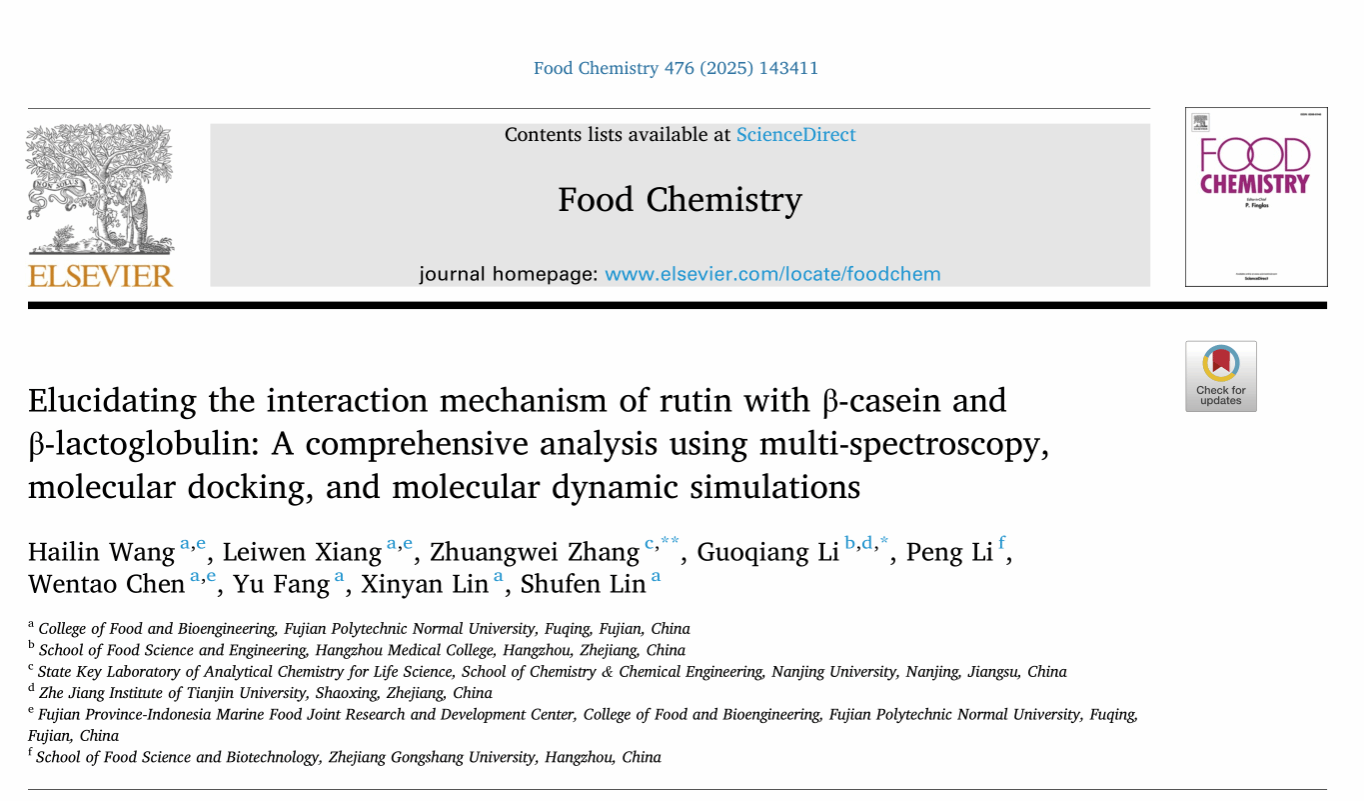
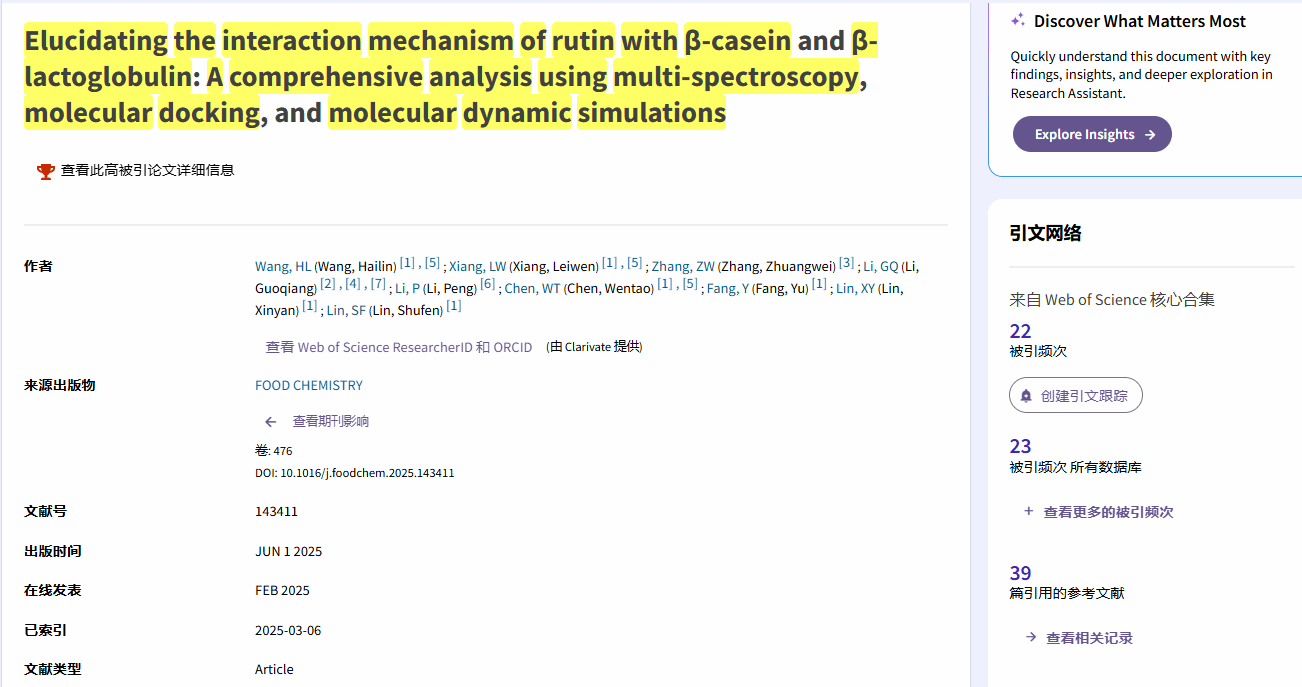
2. Elucidating the interaction mechanism of rutin with β-casein and β-lactoglobulin: A comprehensive analysis using multi-spectroscopy, molecular docking, and molecular dynamic simulations
Research overview: This study investigated the interaction mechanism between rutin and β-casein (β-CAS) and β-lactoglobulin (β-LG) through multispectroscopy, molecular docking and molecular dynamics simulations. Fluorescence spectroscopy indicated that rutin binds spontaneously to both proteins (ΔG < 0), with binding constants of 42.500 × 10³ and 2.101 × 10³ L·mol⁻¹ at 298 K, and 5.814 × 10³ and 4.350 × 10³ L·mol⁻¹ at 308 K, respectively. Multispectral analysis and microscopic techniques confirmed the formation of complexes and revealed changes in the secondary structure, crystal structure and microstructure of the proteins. Molecular docking and kinetic simulations verified the stability of the complex and demonstrated that rutin exhibits a stronger binding affinity for β-CAS. Hydrophobic interactions and hydrogen bonds are the primary forces driving the binding between the two. These findings provide a theoretical basis for the development of lactalbumin as a carrier for rutin and support its potential application in the food industry.
Original link:https://doi.org/10.1016/j.foodchem.2025.143411